Why You Shouldn’t Forbid Your Baby from Eating with Their Hands
 Category Category | Physiology |
|---|
⏱️ Reading time: 3 minutes

Medically reviewed by pediatrician and perinatal psychologist Polina Kizino
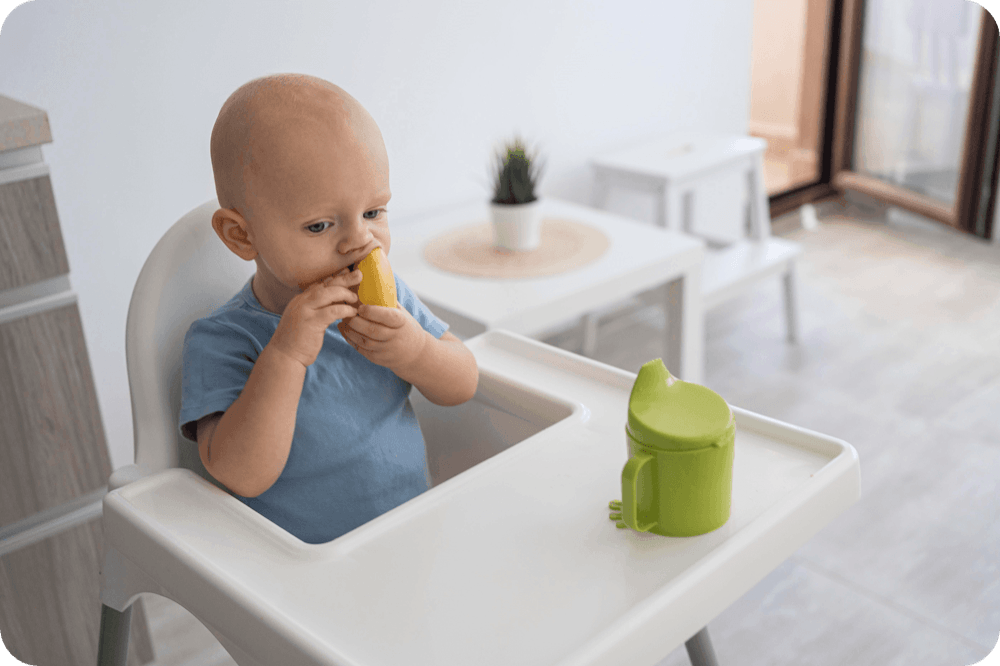
Eating with hands in early childhood is not misbehavior — it’s a vital part of learning. It helps babies explore food textures, build motor skills, and learn to self-regulate hunger. By letting your baby feed themselves, you support their confidence and a healthy relationship with food.

What’s Inside
Quick takeaways
Eating with hands before 1.5–2 years is not misbehavior — it’s a learning process.
Through touch, the baby explores the texture, shape, and properties of food.
This approach supports fine motor development.
The child learns to self-regulate appetite and builds confidence in their eating habits.
Parental support makes the process enjoyable and effective.
Why babies need to eat with their hands
When a baby reaches for a spoon or grabs a piece of food, it’s a natural milestone. Around 8 months, hand-eye coordination improves, and babies begin to purposefully reach.
Eating with hands becomes a playful, meaningful activity. Babies touch, squeeze, taste, and smear food — activating sensory areas of the brain.
They learn what’s soft, cold, or crumbly.
Discouraging this, even with good intentions like “Don’t make a mess” or “Don’t play with food,” robs them of this rich experience.
Why it matters for motor skills
Eating with hands involves palm grasping at first, then develops into a pincer grip — a key milestone. These movements build finger strength and control, preparing them for writing, dressing, and self-care.
The more practice they get, the better fine motor skills develop — and these are closely tied to language centers in the brain.
Your baby develops independence and taste perception
When a child is allowed to feed themselves, they gradually learn to recognize hunger and fullness, and to regulate their behavior during meals.
This forms the basis of mindful eating — an approach where a person eats when hungry and stops when full.
Studies show that children who were allowed to self-feed later have fewer issues with overeating and food-related problems.
Additionally, they develop a positive relationship with food — they’re not afraid to try new things and are more likely to include vegetables, fruits, and a variety of textures in their diet.
Eating with hands builds confidence and trust
Letting your baby eat with their hands says, “I trust you.”
This strengthens self-esteem and initiative and helps the baby feel part of the family experience.
What parents can do
- Prepare the space: bibs, silicone mats, easy-to-clean clothes.
- Let the baby eat, even if half the food ends up spread around — it’s part of learning.
- Don’t scold or take food away — guide and support instead.
- Eat together — mealtime modeling is powerful.
Support instead of control
- Yes, it will be messy — but it’s temporary.
- Skills, confidence, interest in food, and independence will last.
- Treat this as a normal developmental stage, not as "playing with food."
With care
Our articles are based on evidence-based medicine and reviewed by pediatricians. However, they do not replace a consultation with your doctor. Every child is unique — if you have any concerns, please consult a medical professional.
 Essentials for baby care many parents choose
 https://amzn.to/4bc76MW


Some links in this article point to products or resources we genuinely find helpful for this topic. If you choose to buy through them, we may earn a small commission — at no extra cost to you.
Sources
- Brown A, Lee MD. Early influences on child satiety-responsiveness: the role of weaning style. Pediatr Obes. 2015 Feb;10(1):57-66. doi: 10.1111/j.2047-6310.2013.00207.x. Epub 2013 Dec 17. PMID: 24347496. https://pubmed.ncbi.nlm.nih.gov/24347496/. Accessed 7 May 2025.
- Rowan H, Harris C. Baby-led weaning and the family diet. A pilot study. Appetite. 2012 Jun;58(3):1046-9. doi: 10.1016/j.appet.2012.01.033. Epub 2012 Mar 7. PMID: 22406580. https://pubmed.ncbi.nlm.nih.gov/22406580/. Accessed 7 May 2025.
- Townsend E, Pitchford NJ. Baby knows best? The impact of weaning style on food preferences and body mass index in early childhood in a case-controlled sample. BMJ Open. 2012 Feb 6;2(1):e000298. doi: 10.1136/bmjopen-2011-000298. PMID: 22315302; PMCID: PMC4400680. https://pubmed.ncbi.nlm.nih.gov/22315302/. Accessed 7 May 2025.
- Morison BJ, Taylor RW, Haszard JJ, Schramm CJ, Williams Erickson L, Fangupo LJ, Fleming EA, Luciano A, Heath AL. How different are baby-led weaning and conventional complementary feeding? A cross-sectional study of infants aged 6-8 months. BMJ Open. 2016 May 6;6(5):e010665. doi: 10.1136/bmjopen-2015-010665. PMID: 27154478; PMCID: PMC4861100. https://pmc.ncbi.nlm.nih.gov/articles/PMC4861100/. Accessed 7 May 2025.
- Cameron SL, Heath AM, Taylor RWHealthcare professionals’ and mothers’ knowledge of, attitudes to and experiences with, Baby-Led Weaning: a content analysis studyBMJ Open 2012;2:e001542. doi: 10.1136/bmjopen-2012-001542. https://bmjopen.bmj.com/content/2/6/e001542. Accessed 7 May 2025.
- Rapley G. Baby-led weaning: transitioning to solid foods at the baby's own pace. Community Pract. 2011 Jun;84(6):20-3. PMID: 21739856. https://pubmed.ncbi.nlm.nih.gov/21739856/. Accessed 7 May 2025.
- Hetherington MM, Schwartz C, Madrelle J, Croden F, Nekitsing C, Vereijken CM, Weenen H. A step-by-step introduction to vegetables at the beginning of complementary feeding. The effects of early and repeated exposure. Appetite. 2015 Jan;84:280-90. doi: 10.1016/j.appet.2014.10.014. Epub 2014 Oct 18. PMID: 25453593. https://pubmed.ncbi.nlm.nih.gov/25453593/. Accessed 7 May 2025.
- DiSantis KI, Hodges EA, Johnson SL, Fisher JO. The role of responsive feeding in overweight during infancy and toddlerhood: a systematic review. Int J Obes (Lond). 2011 Apr;35(4):480-92. doi: 10.1038/ijo.2011.3. Epub 2011 Mar 22. PMID: 21427696; PMCID: PMC6598438. https://pubmed.ncbi.nlm.nih.gov/21427696/. Accessed 7 May 2025.
- Grote V, Theurich M. Complementary feeding and obesity risk. Curr Opin Clin Nutr Metab Care. 2014 May;17(3):273-7. doi: 10.1097/MCO.0000000000000054. PMID: 24613861. https://pubmed.ncbi.nlm.nih.gov/24613861/. Accessed 7 May 2025.
- Wright CM, Parkinson KN, Drewett RF. Why are babies weaned early? Data from a prospective population based cohort study. Arch Dis Child. 2004 Sep;89(9):813-6. doi: 10.1136/adc.2003.038448. PMID: 15321854; PMCID: PMC1763205. https://pmc.ncbi.nlm.nih.gov/articles/PMC1763205/. Accessed 7 May 2025.