Why It’s Important to Make Simple Requests to Your Baby
 Category Category | Communication |
|---|
⏱️ Reading time: 3 minutes

Medically reviewed by pediatrician Alexandra Zglavosiy
Asking your baby for help lays the foundation for communication and understanding. It supports speech development, attention, and confidence. These small moments of interaction teach your baby how to cooperate, feel capable, and connect with others.

What’s Inside
Quick takeaways
Babies as early as 8 months old can understand simple requests. This supports language, attention, thinking, and social development.
Requests help form a sense of “I can” and lay the groundwork for trust.
These interactions even influence future skills like self-regulation and cooperation.
How baby communication evolves
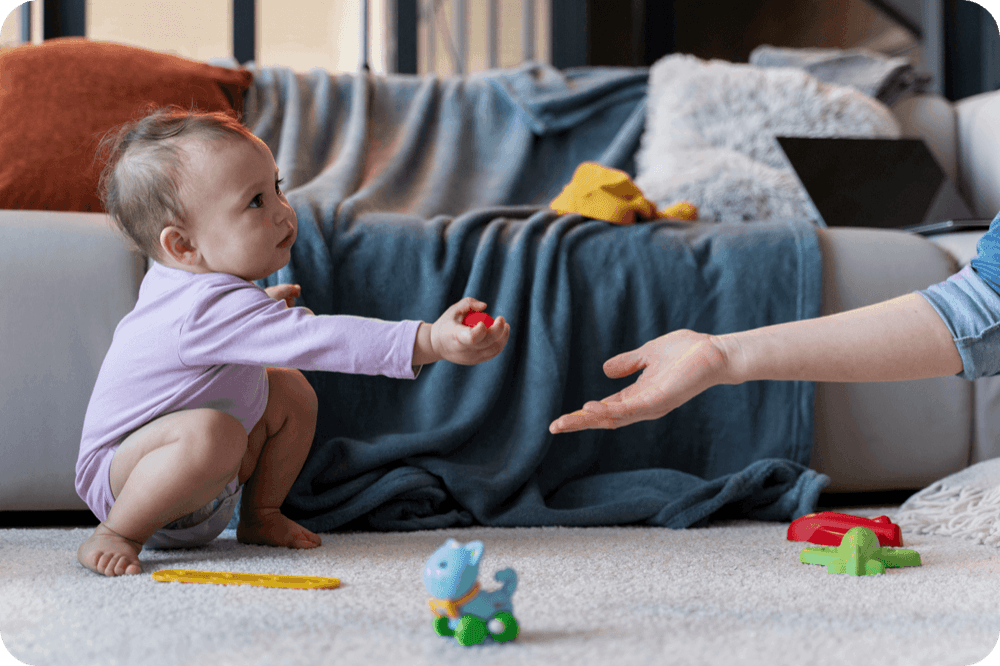
Between 8 and 12 months, babies quickly start to connect words and actions. They notice tone of voice, recognize when someone is speaking to them, and can cooperate in basic ways — handing a toy, waving, nodding, or trying to follow a short instruction. These aren't just cute moments — they’re real brainwork.
Why making requests matters
- It builds joint attention
When you say, “Give me the ball,” you’re not just training an action — you’re guiding your baby’s attention. This shared focus is key for communication, empathy, and learning.
- It supports language understanding
Each request is a short phrase: “Give,” “Open,” “Put.” The baby starts connecting words to actions — this builds a passive vocabulary, and later, active speech.
- The baby feels capable
When the baby hands you a book — it’s not just a gesture. It’s “I did it!” It forms a sense of agency — the belief that their actions matter and they can make choices.
- It teaches cooperation
A request is not a command — it’s an invitation to act together. Cooperation begins here. Even if it doesn’t work every time — the attempt itself builds awareness of others’ intentions.
- It strengthens the parent-child bond
Requests are part of real dialogue. The baby hears you, sees your eyes, feels your presence. You thank them, smile, hug — and that deepens emotional connection.
- It supports motor and cognitive growth
When responding to a request — crawling, picking something up, reaching — the baby uses planning, movement, and coordination. Requests become playful practice, not drills.
- It lays the foundation for self-regulation
Hearing a request teaches the baby to listen, pause, and adjust behavior — the beginning of understanding rules and managing impulses.
What to do daily
- Speak to your baby directly and by name.
- Use simple verbs and gestures: “Give,” “Put,” “Close.”
- Show actions if they don’t understand — don’t rush.
- Praise the effort, even if incomplete.
- Use a soft, encouraging tone — don’t demand.
Signs it’s perfectly normal
- The baby doesn’t always understand but looks at you with interest.
- They act after some delay or only after a demonstration.
- They react to familiar situations but not yet to new words.
When talking to a pediatrician
- By 10–12 months, the baby doesn’t respond to their name or voice.
- They avoid eye contact, even during play.
- They show no interest in speech or don’t try to mimic actions.
With care
Our articles are based on evidence-based medicine and reviewed by pediatricians. However, they do not replace a consultation with your doctor. Every child is unique — if you have any concerns, please consult a medical professional.
 Essentials for baby care many parents choose
 https://amzn.to/4pNGW7T


Some links in this article point to products or resources we genuinely find helpful for this topic. If you choose to buy through them, we may earn a small commission — at no extra cost to you.
Sources
- Kochanska, G., Murray, K. T., & Harlan, E. T. (2000). Effortful control in early childhood: Continuity and change, antecedents, and implications for social development. Developmental Psychology, 36(2), 220–232. https://doi.org/10.1037/0012-1649.36.2.220. Accessed 7 May 2025.
- Adolph, K. E., & Robinson, S. R. (2015). Motor development. In L. S. Liben, U. Müller, & R. M. Lerner (Eds.), Handbook of child psychology and developmental science: Cognitive processes (7th ed., pp. 113–157). John Wiley & Sons, Inc.. https://doi.org/10.1002/9781118963418.childpsy204. Accessed 7 May 2025.
- Tronick, E. (2007). The neurobehavioral and social-emotional development of infants and children. W. W. Norton & Company. https://psycnet.apa.org/record/2006-13259-000. Accessed 7 May 2025.
- Malinda Carpenter, Nameera Akhtar, Michael Tomasello, Fourteen- through 18-month-old infants differentially imitate intentional and accidental actions, Infant Behavior and Development, Volume 21, Issue 2, 1998, Pages 315-330, ISSN 0163-6383, https://doi.org/10.1016/S0163-6383(98)90009-1. Accessed 7 May 2025.
- Teleological reasoning in infancy: the naı̈ve theory of rational action, Gergely, György et al., Trends in Cognitive Sciences, Volume 7, Issue 7, 287 - 292
- Rowe, M.L. and Goldin-Meadow, S. (2009), Early gesture selectively predicts later language learning. Developmental Science, 12: 182-187. https://doi.org/10.1111/j.1467-7687.2008.00764.x. Accessed 7 May 2025.
- Tomasello, M. (2008). Origins of human communication. Boston Review. https://psycnet.apa.org/record/2008-13591-000. Accessed 7 May 2025.