Why It’s Important to Involve Your Baby in Everyday Activities
 Category Category | Communication |
|---|
⏱️ Reading time: 3 minutes

Medically reviewed by pediatrician Alexandra Zglavosiy
Everyday tasks help your baby feel valued and connected. Watching, imitating, and helping strengthen coordination, language, and confidence. Even simple actions like putting clothes away or playing with a spoon build attachment and support independence.

What’s Inside
Quick takeaways
Joint activities with parents strengthen attachment and trust.
The baby learns to observe, imitate, remember, and perform simple tasks.
Even symbolic participation helps develop coordination, speech, and self-awareness.
Talking during these activities helps babies understand and respond to speech faster. It’s one of the first steps toward independence and initiative.
What daily tasks can you involve your baby in
In the kitchen
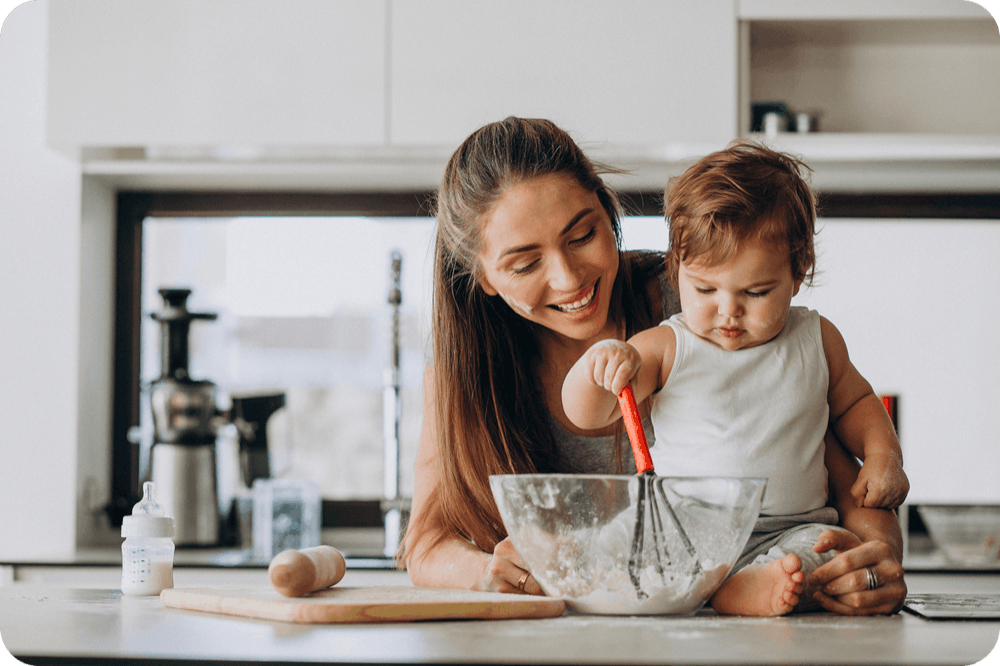
Let your baby sit nearby in a safe high chair while you narrate what you're doing:
“Now I’m cutting an apple. A red apple. Want to smell it?” Once your baby can stand steadily, you can use a learning tower so they can stand safely next to you.
Give them safe items like a wooden spoon or plastic container to “help.”
With laundry
Show how you toss clothes into the basket and invite your baby to do the same. Even if they just reach or touch — that’s already a shared action.
Cleaning
A small cloth or toy brush helps them feel like “mom” or “dad.” The goal isn’t results — it’s participation and joy in the process.
Why it matters
Attachment and a sense of belonging
Shared activities create a “we’re in this together” feeling, helping your baby feel needed and loved.
Babies learn by doing, not by instruction. It’s the key to cultural learning and self-confidence.
Cognitive and speech development
By observing and copying, your baby not only learns movement but starts understanding what adults do and why. They also learn new words you use.
Motor skills and coordination
Holding a spoon, wiping with a cloth, putting clothes in a basket — all use hands, fingers, eyes, and the brain together.
Self-esteem and initiative
Letting your baby take part shows them that their actions matter — building confidence and motivation.
When to start
Start around 6–7 months, when your baby sits well and shows interest in what adults are doing. At first it’s just observing, then pretend play, and by age one — real attempts to help.
The golden rule is: safety and no pressure. Even just watching means learning.
What matters most — being together
Involving your baby in daily tasks isn’t about productivity. It’s about bonding, experience, trust, and growth. If your baby is nearby and watching with interest — and you’re narrating with a smile — you’re already doing it right.
With care
Our articles are based on evidence-based medicine and reviewed by pediatricians. However, they do not replace a consultation with your doctor. Every child is unique — if you have any concerns, please consult a medical professional.
 Essentials for baby care many parents choose
 https://amzn.to/3NfRtu0


Some links in this article point to products or resources we genuinely find helpful for this topic. If you choose to buy through them, we may earn a small commission — at no extra cost to you.
Sources
- Tomasello, M. (2008). Origins of human communication. Boston Review. https://psycnet.apa.org/record/2008-13591-000. Accessed 7 May 2025.
- Rogoff, B. (2003). The Cultural Nature of Human Development. Oxford University Press. ISBN-10: 0195131339
- Trevarthen, C. (1998). The concept and foundations of infant intersubjectivity. In S. Bråten (Ed.), Intersubjective communication and emotion in early ontogeny (pp. 15–46). Cambridge University Press. https://psycnet.apa.org/record/1999-02453-001. Accessed 7 May 2025.
- Bakeman R, Adamson LB. Coordinating attention to people and objects in mother-infant and peer-infant interaction. Child Dev. 1984 Aug;55(4):1278-89. PMID: 6488956. https://pubmed.ncbi.nlm.nih.gov/6488956/. Accessed 7 May 2025.
- Zeanah, C. (1986). The Interpersonal World of the Infant: A View from Psychoanalysis and Developmental Psychology. Journal of the American Academy of Child Psychiatry. https://www.academia.edu/51855748/The_Interpersonal_World_of_the_Infant_A_View_from_Psychoanalysis_and_Developmental_Psychology. Accessed 7 May 2025.
- Carpendale JI, Lewis C. Constructing an understanding of mind: the development of children's social understanding within social interaction. Behav Brain Sci. 2004 Feb;27(1):79-96; discussion 96-151. doi: 10.1017/s0140525x04000032. PMID: 15481944. https://pubmed.ncbi.nlm.nih.gov/15481944/. Accessed 7 May 2025.
- Gopnik, Alison & Meltzoff, Andrew & Kuhl, Patricia. (2001). The Scientist in the Crib: Minds, Brains and How Children Learn. 10.1097/00005053-200103000-00011. https://www.researchgate.net/publication/232456333_The_Scientist_in_the_Crib_Minds_Brains_and_How_Children_Learn. Accessed 7 May 2025.