When Your Baby's Cry Deserves Attention
 Category Category | Physiology |
|---|
⏱️ Reading time: 4 minutes

Medically reviewed by pediatrician Alexandra Zglavosiy
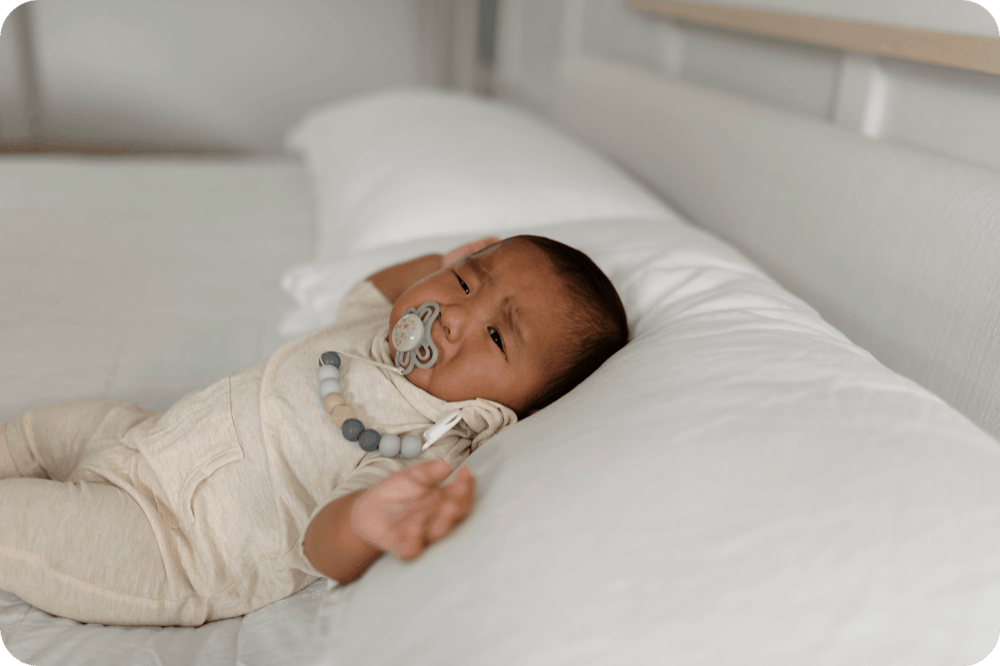
Crying is normal — it’s how your baby asks for food, comfort, or sleep. But if the crying sounds unusual, comes with a fever, low energy, or refusal to eat — it's best to check with a doctor. Sometimes, crying means your baby needs help.

What’s Inside
Quick takeaways
Crying is a baby’s main form of communication — not manipulation. It signals hunger, tiredness, discomfort, or the need for closeness.
Red flags: crying with a fever (above 99.5°F), rash, vomiting, weak or hoarse cry, refusal to eat, unusual sleepiness, pale or bluish skin.
Soothing strategies: white noise, skin-to-skin contact, gentle techniques, babywearing, or a car ride.
Responding to your baby’s cries builds trust and emotional security.
If you feel overwhelmed, it's okay to take a short break and ask for help. Crying is not your fault.
Crying is more than a sound — it’s your baby’s first language
At 1–2 months, your baby can’t talk or gesture. Crying is how they express needs, discomfort, or a desire for connection.
Crying isn’t manipulation — it’s a vital survival tool
You should always respond to your baby’s cry
You might hear that if you pick up your baby every time they cry, you’ll spoil them.
But modern science says otherwise: consistently responding to your baby’s needs builds their sense of safety and trust.
Babies who feel secure early on tend to grow into more confident and independent children.
Common reasons why babies cry at 1–2 months
- Hunger: the most frequent reason, especially 1–3 hours after feeding
- Dirty or wet diaper: many babies dislike feeling even slightly wet
- Wanting to be held: physical closeness makes babies feel safe
- Tiredness: paradoxically, babies often cry to signal they need sleep
- Gas or colic: often in the evening, with legs pulling up to the belly
- Overstimulation: bright lights, noise, or too much activity
- Boredom: even tiny babies crave interaction and novelty
- Temperature discomfort: too hot or too cold can trigger tears
Babies have different “melodies” of crying
Over time, you may learn to tell them apart.
- Hunger cry: rhythmic, builds gradually, with pauses and rooting
- Pain cry: sudden, sharp, high-pitched
- Tired cry: whiny or grumbly, often with yawning or rubbing eyes
- Boredom cry: intermittent and stops with a change of scene
Purple Crying is often confused with colic
PURPLE Crying is a normal but intense phase of crying in healthy infants.
It’s not the same as colic (which includes digestive symptoms), but can feel just as hard.
The acronym PURPLE helps describe it:
- P (Peak): crying peaks around 6–8 weeks
- U (Unexpected): crying starts suddenly, without a clear cause
- R (Resists soothing): nothing seems to work
- P (Pain-like face): baby looks distressed, even if not in pain
- L (Long-lasting): crying can last up to 5 hours
- E (Evening): crying often increases in the afternoon and evening
- Typically begins before 5 months of age
- Episodes often occur in clusters
- Common soothing strategies may not work
- Weight gain is normal; there’s no fever or illness
- If your baby cries ≥3 hours/day at least 3 days/week — or this pattern appears in your diary — talk to your pediatrician to rule out other causes.
- Purple crying fades on its own, usually by 3–4 months
Soothing strategies to try during intense crying
- Swaddling: secure, snug wrapping to mimic the womb
- White noise: fan, vacuum, or white noise apps
- Rocking or bouncing: gentle rhythmic motion
- Skin-to-skin contact: baby on your chest calms stress
- Change of scenery: walk to another room or step outside
When to call your pediatrician
- Cry sounds weak, hoarse, or high-pitched like a cat’s cry
- Fever above 99.5°F (37.5°C)
- Refusing to feed (especially 2+ feedings in a row)
- Excessive sleepiness or hard to wake up
- Pale or bluish skin, or rash
- Sudden change in crying — from calm to intense and unusual
Chronic crying is exhausting — take care of yourself too
- Trade off soothing time with your partner
- Try headphones and calming music if crying overwhelms you
- Take short breaks — put baby in a safe place and breathe
- Ask friends or family for help
Crying is temporary. You are not failing. You’re doing your best.
With care
Our articles are based on evidence-based medicine and reviewed by pediatricians. However, they do not replace a consultation with your doctor. Every child is unique — if you have any concerns, please consult a medical professional.
 Essentials for baby care many parents choose
 https://amzn.to/3XHYSUY


Some links in this article point to products or resources we genuinely find helpful for this topic. If you choose to buy through them, we may earn a small commission — at no extra cost to you.
Sources
- Marcdante KJ, Kliegman RM, Shu A. Crying and Colic. In: Marcdante KJ, Kliegman RM, Shu A, eds. Nelson Essentials of Pediatrics. 9th ed. Philadelphia, PA: Elsevier; 2023: chapter 11. ISBN: 9780323775625
- Onigbanjo MT, Feigelman S. The First Year. In: Kliegman RM, St. Geme JW, Blum NJ, Shah SS, Tasker RC, Wilson KM, eds. Nelson Textbook of Pediatrics. 21st ed. Philadelphia, PA: Elsevier; 2020: chapter 22. ISBN: 9780323529501
- Pomeranz AJ, Sabnis S, Busey SL, Kliegman RM. The Irritable Infant (Fussy or Excessively Crying Infant). In: Pomeranz AJ, Sabnis S, Busey SL, Kliegman RM, eds. Pediatric Decision-Making Strategies. 2nd ed. Philadelphia, PA: Elsevier Saunders; 2016: chapter 79. ISBN: 9780323298544
- “Why do babies cry? Learn how to translate your child’s first language”, UNICEF, https://www.unicef.org/parenting/child-care/why-babies-cry. Accessed 1 Apr. 2025.
- “Purple Crying”, Cleveland Clinic, https://my.clevelandclinic.org/health/articles/purple-crying. Accessed 1 Apr. 2025.
- Reese LS, Heiden EO, Kim KQ, Yang J. Evaluation of Period of PURPLE Crying, an abusive head trauma prevention program. J Obstet Gynecol Neonatal Nurs. 2014 Nov-Dec;43(6):752-61. doi: 10.1111/1552-6909.12495. Epub 2014 Aug 18. PMID: 25134950. https://pubmed.ncbi.nlm.nih.gov/25134950/. Accessed 1 Apr. 2025.
- Öztürk Dönmez R, Bayik Temel A. Effect of soothing techniques on infants' self-regulation behaviors (sleeping, crying, feeding): A randomized controlled study. Jpn J Nurs Sci. 2019 Oct;16(4):407-419. doi: 10.1111/jjns.12250. Epub 2019 Feb 6. PMID: 30729735. https://pubmed.ncbi.nlm.nih.gov/30729735/. Accessed 8 Apr. 2025.
- Harvey Karp, "The Happiest Baby on the Block. Fully Revised and Updated Second Edition: The New Way to Calm Crying and Help Your Newborn Baby Sleep Longer", Bantam, 2015. ISBN-10: 9780553393231
- Field T. Infant Massage Therapy Research Review. Clin Res Pediatr 2018;1(2):1-9. https://lifestagemassage.com/wp-content/uploads/2022/12/Infant-Massage-Research-Review.pdf. Accessed 8 Apr. 2025.
- Ainsworth MDS. The Bowlby-Ainsworth attachment theory. Behavioral and Brain Sciences. 1978;1(3):436-438. doi:10.1017/S0140525X00075828. https://www.cambridge.org/core/journals/behavioral-and-brain-sciences/article/abs/bowlbyainsworth-attachment-theory/3915528486A6062F4DBEF0720406C462. Accessed 8 Apr. 2025.