What Is Object Manipulation and How to Help Your Baby Develop This Skill
 Category Category | Motor activity |
|---|
⏱️ Reading time: 3 minutes

Medically reviewed by pediatrician Alexandra Zglavosiy
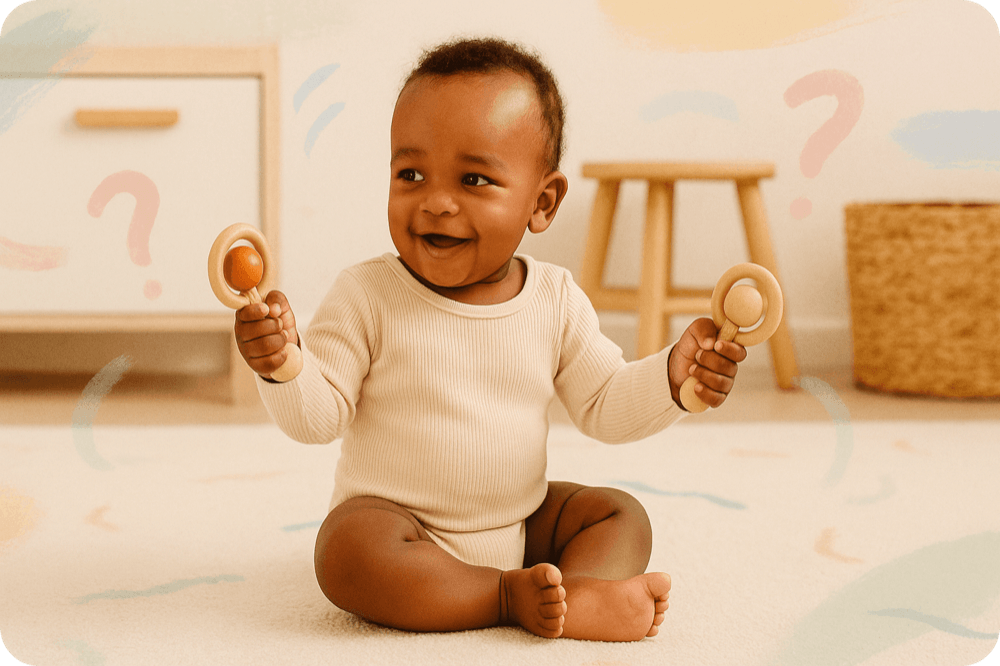
When a baby starts grabbing, squeezing, and transferring objects, they’re learning to control their movements and explore the world with their hands. This important milestone helps develop the brain, coordination, and attention. Support their curiosity — offer toys with different textures, play together, and encourage every attempt to explore.

What’s Inside
Quick takeaways
Between 4–6 months, babies start to purposefully grasp, squeeze, shake, and transfer objects.
This is a key stage of sensorimotor development that affects future cognitive skills.
Simple games, toys with different textures, and parental involvement are the best tools for learning.
If by 5–6 months the baby isn’t using their hands during play, consult your pediatrician.
Your baby’s hands become tools to explore the world
Around 4 months, a baby reaches an important milestone: they no longer just accidentally brush against things, but reach for them intentionally. This is the start of conscious motor control.
Later — around 5–6 months — babies begin to transfer objects from one hand to the other. This shows improved bilateral coordination and spatial awareness — skills that form the basis for using a spoon or drawing in the future.
Manipulating objects helps develop the brain and body
When a baby crumples a soft book, chews a teether, or bangs a toy on the floor, they are simultaneously:
- exploring texture, weight, shape, and sound
- developing grip strength and movement precision
- training hand-eye coordination
- forming cause-and-effect understanding (e.g. squeezing = noise)
- enjoying their actions — which motivates continued exploration
Support the skill with simple daily routines
Here’s how you can help your baby master manipulation:
- Encourage grasping. Offer lightweight, easy-to-hold toys — rings, teethers, soft blocks. They’re easier to grab with both hands.
- Demonstrate and narrate. Name objects, describe their color and shape, show how to interact with them.
- Promote transferring. Give your baby one toy and observe how they try to move it from hand to hand.
- Continue tummy time. It strengthens the back and shoulders, supporting hand control and reaching.
Games and toys to strengthen object manipulation
Ideal options include:
- Crinkly fabric books, textured balls — for sensory play
- Mirror play during tummy time — to watch and reach for their reflection
- Simple toys with buttons or movement — from 6 months onward
- DIY toys — tightly sealed zip bags with grains or floating objects inside water
When to talk to your pediatrician
Every baby develops at their own pace. But check in with your doctor if you notice:
- No reaching for toys after 4 months
- No attempts to grab or hold objects by 5 months
- Arm movements stay random and don’t improve
- No interest in new or fun toys
- Significant asymmetry — e.g. only using one hand
With care
Our articles are based on evidence-based medicine and reviewed by pediatricians. However, they do not replace a consultation with your doctor. Every child is unique — if you have any concerns, please consult a medical professional.
 Essentials for baby care many parents choose
 https://amzn.to/4qvRbOh


Some links in this article point to products or resources we genuinely find helpful for this topic. If you choose to buy through them, we may earn a small commission — at no extra cost to you.
Sources
- Corbetta, Daniela, Rebecca F. Wiener, Sabrina L Thurman and Emalie McMahon. “The Embodied Origins of Infant Reaching: Implications for the Emergence of Eye-Hand Coordination.” Kinesiology Review 7 (2018): 10-17.
- Morange-Majoux F. Manual exploration of consistency (soft vs hard) and handedness in infants from 4 to 6 months old. Laterality. 2011 May;16(3):292-312. doi: 10.1080/13576500903553689. Epub 2010 Jul 12. PMID: 20628962. https://pubmed.ncbi.nlm.nih.gov/20628962/. Accessed 17 Apr. 2025.
- Heathcock JC, Lobo M, Galloway JC. Movement training advances the emergence of reaching in infants born at less than 33 weeks of gestational age: a randomized clinical trial. Phys Ther. 2008 Mar;88(3):310-22. doi: 10.2522/ptj.20070145. Epub 2007 Dec 20. PMID: 18096650. https://pubmed.ncbi.nlm.nih.gov/18096650/. Accessed 17 Apr. 2025.
- Chang L, de Barbaro K, Deák G. Contingencies Between Infants' Gaze, Vocal, and Manual Actions and Mothers' Object-Naming: Longitudinal Changes From 4 to 9 Months. Dev Neuropsychol. 2016 Jul-Dec;41(5-8):342-361. doi: 10.1080/87565641.2016.1274313. PMID: 28253035. https://pubmed.ncbi.nlm.nih.gov/28253035/. Accessed 17 Apr. 2025.
- Case-Smith, J. (2016). Occupational Therapy for Children and Adolescents. eBook ISBN: 9780323512626
- “Back to sleep, tummy to play”, American Academy of Pediatrics, (2017), https://www.healthychildren.org/English/ages-stages/baby/sleep/Pages/Back-to-Sleep-Tummy-to-Play.aspx. Accessed 1 Apr. 2025.
- Hewitt L, Kerr E, Stanley RM, Okely AD. Tummy Time and Infant Health Outcomes: A Systematic Review. Pediatrics. 2020 Jun;145(6):e20192168. doi: 10.1542/peds.2019-2168. Epub 2020 May 5. PMID: 32371428. https://pubmed.ncbi.nlm.nih.gov/32371428/. Accessed 2 Apr. 2025.