How to Stimulate Speech Development
 Category Category | Communication |
|---|
⏱️ Reading time: 4 minutes

Medically reviewed by pediatrician Alexandra Zglavosiy
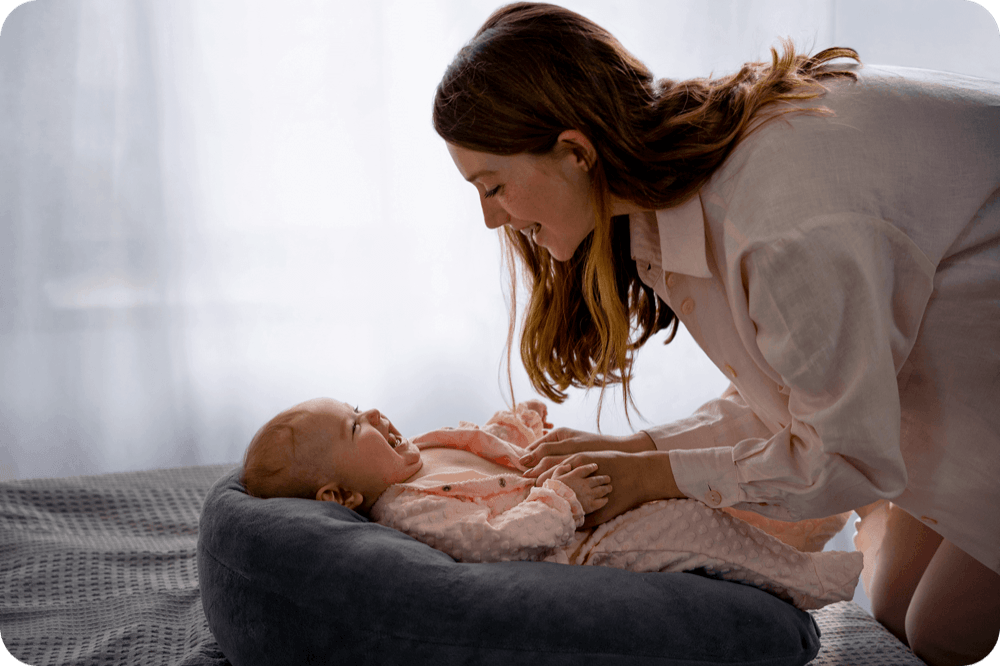
Babies learn to speak through joyful, real-life interaction. Talk to your baby every day, repeat their sounds, read, and sing together. These activities help build language skills. Face-to-face contact matters more than screens. If your baby isn’t babbling or responding to voices by 10 months, check with your pediatrician.

What’s Inside
Quick takeaways
Your baby learns to talk through joyful, lively interaction — talk to them daily, even if they don’t answer with words yet.
Babbling and sounds are already a form of speech. Repeat them, comment, and smile back.
Books, songs, nursery rhymes, and gestures all help develop speech. What matters most is doing it together.
TV and YouTube don’t develop speech — the brain needs feedback, connection, and a face that responds.
Don’t pressure your baby — language grows through enjoyment and emotional connection.
If your baby isn’t babbling, mimicking, or responding to voices by 10 months, consult a doctor.
Why support speech development
Speech development begins long before the first words. Your baby learns to talk through observation, imitation, and emotional response. They watch your lips, tone, and reactions. The more you talk with your baby, the faster they learn sounds, speech rhythm, and word meaning.
Babies who are spoken to regularly have a noticeably larger vocabulary by 18 months. Responding to babbling strengthens neural connections tied to speech and cognitive development.
What to do every day
- Talk to your baby like a conversation partner. Describe your actions and the world around you: “Now we’re putting on your hat,” “Look, a bird flew by.” Speak slowly and clearly with a warm tone. Babies understand better when speech is directed at them with eye contact and facial expressions.
- Respond to babbling. If your baby says “ba-ba,” repeat it, smile, and add: “Ba-ba! What a little chatterbox!” This shows your baby their sounds matter. The more adults respond, the more varied the baby’s sounds become.
- Read and sing. Even simple rhymes and repetitive books help babies process speech. Songs with gestures also support coordination. Regular reading and singing improve phonemic awareness — the ability to distinguish and reproduce sounds.
- Comment on surrounding sounds. “Do you hear that? It’s a car,” “The bird is singing.” These phrases help babies connect sounds to words, developing auditory attention and meaning.
- Use gestures with words. Wave “bye-bye” as you say it. Point at a toy as you name it. This helps babies connect words with actions and memorize them faster. Early gestures are directly linked to faster verbal development.
What not to do
- Don’t rely on TV or YouTube. Even bright kids’ shows can’t replace face-to-face interaction. Babies need real-time response, eye contact, and expressions to learn.
- Don’t “train” speech. Repeating “Say mama” doesn’t help much. What works is a happy, communicative atmosphere.
- Don’t ignore babbling. Even an “ah-ah” deserves a response — it shows their voice matters.
When to consult a doctor
If by 10 months your baby:
- doesn’t babble (no repeated syllables like “ba-ba,” “ma-ma”)
- doesn’t turn to voices
- doesn’t mimic sounds
- shows no interest in faces or communication
In such cases, speak to a pediatrician or early development specialist. Speech is sensitive, and early support makes a big difference.
With care
Our articles are based on evidence-based medicine and reviewed by pediatricians. However, they do not replace a consultation with your doctor. Every child is unique — if you have any concerns, please consult a medical professional.
 Essentials for baby care many parents choose
 https://amzn.to/4pui5oR


Some links in this article point to products or resources we genuinely find helpful for this topic. If you choose to buy through them, we may earn a small commission — at no extra cost to you.
Sources
- Zimmerman FJ, Christakis DA, Meltzoff AN. Associations between media viewing and language development in children under age 2 years. J Pediatr. 2007 Oct;151(4):364-8. doi: 10.1016/j.jpeds.2007.04.071. Epub 2007 Aug 7. PMID: 17889070. https://pubmed.ncbi.nlm.nih.gov/17889070/. Accessed 7 May 2025.
- Goldstein MH, Schwade JA. Social feedback to infants' babbling facilitates rapid phonological learning. Psychol Sci. 2008 May;19(5):515-23. doi: 10.1111/j.1467-9280.2008.02117.x. PMID: 18466414. https://pubmed.ncbi.nlm.nih.gov/18466414/. Accessed 7 May 2025.
- Rowe ML, Goldin-Meadow S. Early gesture selectively predicts later language learning. Dev Sci. 2009 Jan;12(1):182-7. doi: 10.1111/j.1467-7687.2008.00764.x. PMID: 19120426; PMCID: PMC2677374. https://pmc.ncbi.nlm.nih.gov/articles/PMC2677374/. Accessed 7 May 2025.
- Weisleder A, Fernald A. Talking to children matters: early language experience strengthens processing and builds vocabulary. Psychol Sci. 2013 Nov 1;24(11):2143-52. doi: 10.1177/0956797613488145. Epub 2013 Sep 10. PMID: 24022649; PMCID: PMC5510534. Accessed 7 May 2025. https://pmc.ncbi.nlm.nih.gov/articles/PMC5510534/.
- Kuhl PK. Is speech learning 'gated' by the social brain? Dev Sci. 2007 Jan;10(1):110-20. doi: 10.1111/j.1467-7687.2007.00572.x. PMID: 17181708. https://pubmed.ncbi.nlm.nih.gov/17181708/. Accessed 7 May 2025.
- Brito NH, Troller-Renfree SV, Leon-Santos A, Isler JR, Fifer WP, Noble KG. Associations among the home language environment and neural activity during infancy. Dev Cogn Neurosci. 2020 Jun;43:100780. doi: 10.1016/j.dcn.2020.100780. Epub 2020 Apr 25. PMID: 32510343; PMCID: PMC7200831. https://pmc.ncbi.nlm.nih.gov/articles/PMC7200831/. Accessed 7 May 2025.
- Hirsh-Pasek K, Adamson LB, Bakeman R, Owen MT, Golinkoff RM, Pace A, Yust PK, Suma K. The Contribution of Early Communication Quality to Low-Income Children's Language Success. Psychol Sci. 2015 Jul;26(7):1071-83. doi: 10.1177/0956797615581493. Epub 2015 Jun 5. PMID: 26048887. https://pubmed.ncbi.nlm.nih.gov/26048887/. Accessed 7 May 2025.