How to Improve Walking Skills
 Category Category | Motor activity |
|---|
⏱️ Reading time: 2 minutes

Medically reviewed by pediatrician and perinatal psychologist Polina Kizino
Babies learn to walk through play and movement — at their own pace and without gear. What helps most is a safe space at home, time barefoot, kind encouragement, and playful activities with parents. Don’t rush or compare — just enjoy every step.

What’s Inside
Quick takeaways
Most babies start taking their first steps between 9 and 18 months.
The best thing parents can provide is a safe space and the freedom to move.
Barefoot on the floor, chasing a ball, walking toward mom — natural stimuli work better than baby gear.
Confidence in walking comes through repetition, trial, and error.
Not all babies develop the same way — each child’s pace is unique.
How walking develops in babies
Walking is a complex skill that requires coordination, muscle strength, and balance. Before their first birthday, babies go through key stages: learning to sit, crawl, pull up, stand, and take supported steps. Independent walking usually appears between 10 and 18 months.
At this stage, it’s important to:
- Create a safe, open space for movement
- Support your child’s attempts to stand, take steps, and reach for toys
- Celebrate together — emotional support boosts motivation
Why barefoot is better
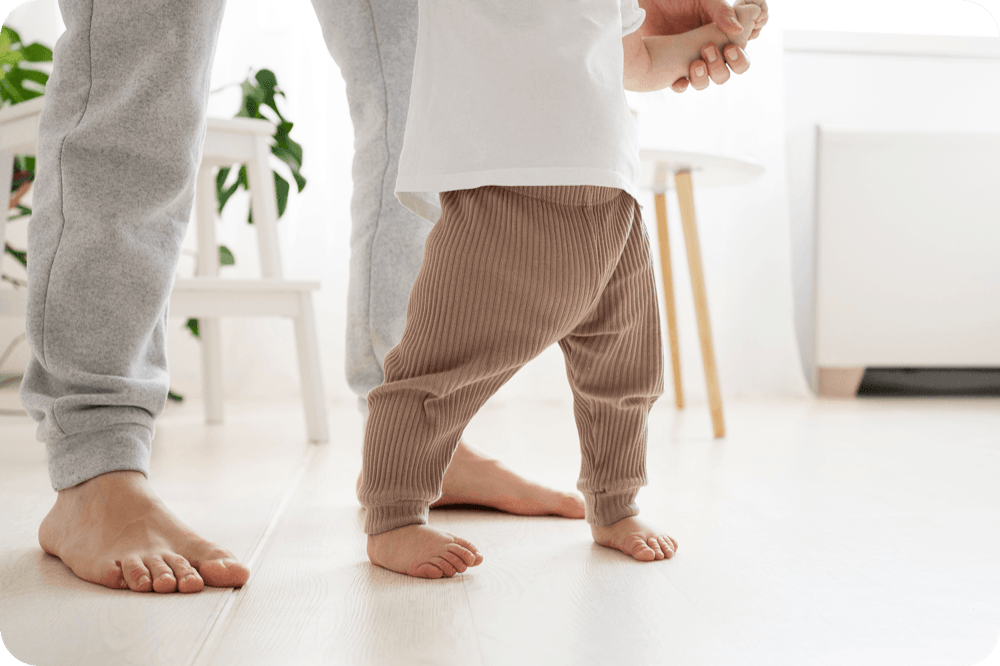
Walking barefoot on a flat, safe surface helps:
- Develop the small muscles in the feet
- Improve coordination and balance
- Provide tactile and proprioceptive input (the body’s sense of position in space)
Shoes are only needed outdoors — at home, walking barefoot or in non-slip socks is best
What doesn’t help
Despite their popularity, walkers and jumpers do not promote walking skills. In fact, they can:
- Disrupt natural movement mechanics
- Increase the risk of injury
- Delay skill acquisition
- Even lead to lower limb deformities
How to build walking skills through play
Movement is play — and play is the best training. Here’s what works:
- Hide a toy to encourage the baby to walk toward it
- Sit and stand together, practice picking things up from the floor
- Try balance activities — kneeling, stepping over small obstacles
- Play musical or active games like “come here!” or “chase me!”
A baby learns best when they’re having fun
What pace is normal
Parents often worry: “What if my child is behind?” It’s important to remember:
- Every child develops at their own pace
- A variation of up to 3 months in either direction is normal
- Progress matters most: if your baby is starting to take supported steps, the skill is developing
- If your child isn’t walking by 18 months and has no other motor milestones, talk to your pediatrician
With care
Our articles are based on evidence-based medicine and reviewed by pediatricians. However, they do not replace a consultation with your doctor. Every child is unique — if you have any concerns, please consult a medical professional.
 Essentials for baby care many parents choose
 https://amzn.to/4jmbUSg


Some links in this article point to products or resources we genuinely find helpful for this topic. If you choose to buy through them, we may earn a small commission — at no extra cost to you.
Sources
- Adolph, K.E. and Tamis-LeMonda, C.S. (2014), The Costs and Benefits of Development: The Transition From Crawling to Walking. Child Dev Perspect, 8: 187-192. https://doi.org/10.1111/cdep.12085. Accessed 7 May 2025.
- and de Onis, M. (2006), WHO Motor Development Study: Windows of achievement for six gross motor development milestones. Acta Pædiatrica, 95: 86-95. https://doi.org/10.1111/j.1651-2227.2006.tb02379.x. Accessed 7 May 2025.
- Ariel Sims, Thitphalak Chounthirath, Jingzhen Yang, Nichole L. Hodges, Gary A. Smith; Infant Walker–Related Injuries in the United States. Pediatrics October 2018; 142 (4): e20174332. 10.1542/peds.2017-4332. https://publications.aap.org/pediatrics/article-abstract/142/4/e20174332/37420/Infant-Walker-Related-Injuries-in-the-United. Accessed 7 May 2025.
- Infant development: Milestones from 10 to 12 months, Mayo Clinic, https://www.mayoclinic.org/healthy-lifestyle/infant-and-toddler-health/in-depth/infant-development/art-20047380. Accessed 7 May 2025.
- Are Infant Walkers Safe? Here’s What New Parents Need to Know, Cleveland Clinic, https://health.clevelandclinic.org/are-infant-walkers-safe. Accessed 7 May 2025.