How to Help Your Baby Stand Without Support
 Category Category | Motor activity |
|---|
⏱️ Reading time: 2 minutes

Medically reviewed by pediatrician Alexandra Zglavosiy
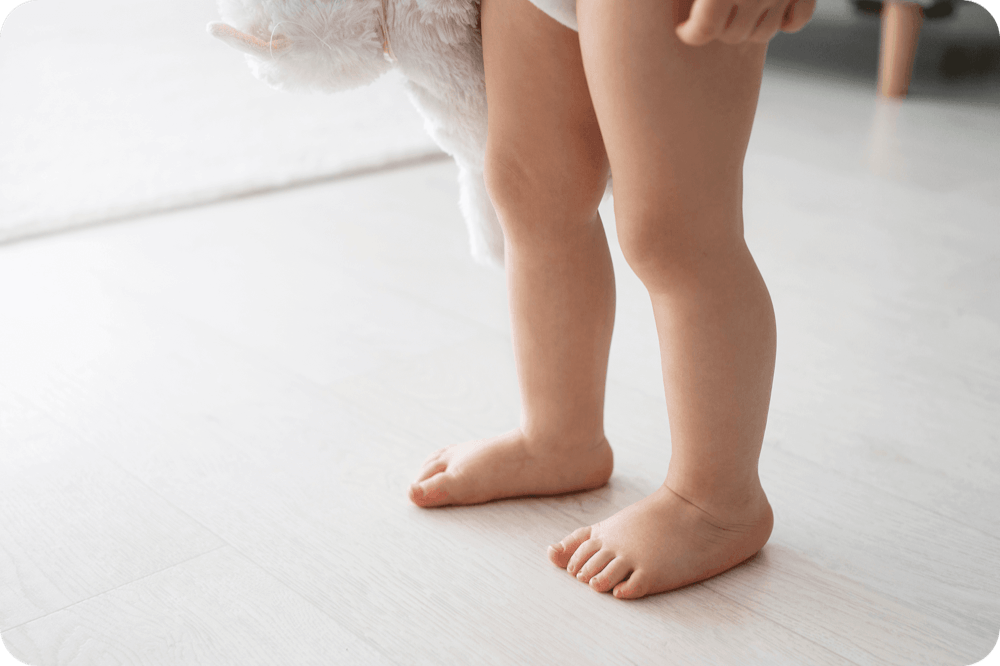
Around their first birthday, babies often try standing on their own — what they need is your calm support and space to explore. Gentle encouragement and playful moments help build their confidence step by step.

What’s Inside
Quick takeaways
Babies usually start trying to stand without support around their first birthday.
Your main role is to provide safety, patience, and encouragement.
Simple games and encouraging movement help build your baby’s confidence.
Every child develops at their own pace — and that’s okay.
What’s happening at this age
By 10–12 months, most babies can stand confidently while holding onto something and begin showing interest in letting go. During this period, leg muscles strengthen, balance improves, and the vestibular system develops — all of which support independent standing.
From a neurological perspective, your baby is learning to “hold their center of gravity” in new conditions. This requires coordinated work between the brain, muscles, and sensory systems.
How to create the right conditions for confident standing
To encourage your baby to try standing without support:
- Remove slippery rugs and items that may trip them
- Use a non-slip, soft mat to cushion falls
- Place stable furniture nearby for holding onto
- Be present — your presence boosts their confidence
What parents can do: simple and effective techniques
- “Reach for the toy”. Hold a favorite toy just out of reach and slightly above your baby. They may instinctively let go of support to reach for it.
- “Kneeling games”. Encourage your baby to kneel next to furniture, then push up onto their feet. This strengthens thigh and core muscles.
- “Stand together”. Stand in front of your baby and hold their hands. As they gain balance, gently loosen your grip to let them try standing on their own.
Safety first
Don’t rush the process — standing too early may cause unnecessary physical and emotional stress.
Avoid using walkers and jumpers — they interfere with stability development.
The best setup is floor time, barefoot, in comfortable clothes.
Individual pace is normal
Some babies stand without support at 9 months, others closer to 14. It depends on muscle tone, temperament, and previous motor experiences.
The key is not to compare or rush — just observe and support. If you’re concerned about any symptoms, talk to your pediatrician.
With care
Our articles are based on evidence-based medicine and reviewed by pediatricians. However, they do not replace a consultation with your doctor. Every child is unique — if you have any concerns, please consult a medical professional.
 Essentials for baby care many parents choose
 https://amzn.to/4prKJYt


Some links in this article point to products or resources we genuinely find helpful for this topic. If you choose to buy through them, we may earn a small commission — at no extra cost to you.
Sources
- Developmental Delay in Children, Cleveland Clinic, https://my.clevelandclinic.org/health/diseases/14814-developmental-delay-in-children. Accessed 7 May 2025.
- Developmental Delays in Young Children, WebMD, https://www.webmd.com/parenting/baby/recognizing-developmental-delays-birth-age-2. Accessed 7 May 2025.
- Wilson RB, Enticott PG, Rinehart NJ. Motor development and delay: advances in assessment of motor skills in autism spectrum disorders. Curr Opin Neurol. 2018 Apr;31(2):134-139. doi: 10.1097/WCO.0000000000000541. PMID: 29493557; PMCID: PMC8653917. https://pmc.ncbi.nlm.nih.gov/articles/PMC8653917/. Accessed 7 May 2025.
- Elshafey MA, Abdrabo MS, Elnaggar RK. Effects of a core stability exercise program on balance and coordination in children with cerebellar ataxic cerebral palsy. J Musculoskelet Neuronal Interact. 2022 Jun 1;22(2):172-178. PMID: 35642697; PMCID: PMC9186458. https://pmc.ncbi.nlm.nih.gov/articles/PMC9186458/. Accessed 7 May 2025.
- Yu JJ, Burnett AF, Sit CH. Motor Skill Interventions in Children With Developmental Coordination Disorder: A Systematic Review and Meta-Analysis. Arch Phys Med Rehabil. 2018 Oct;99(10):2076-2099. doi: 10.1016/j.apmr.2017.12.009. Epub 2018 Jan 9. PMID: 29329670. https://pubmed.ncbi.nlm.nih.gov/29329670/. Accessed 7 May 2025.