How Sleep Routines Evolve Between Day and Night Sleep
 Category Category | Sleep |
|---|
⏱️ Reading time: 4 minutes

Medically reviewed by pediatrician and perinatal psychologist Polina Kizino
Sleep routines become more meaningful around the first birthday. As toddlers drop to one nap and become more aware of transitions, predictable steps before sleep help them settle down and feel safe — even during protest.

What’s Inside
Quick takeaways
By 12–18 months, most babies transition from two naps to one.
Bedtime rituals become more structured and conscious.
Resistance to sleep increases due to the development of will and emotions.
Predictable steps before sleep help babies feel safe.
A common case is the “false nap drop”: a baby may take only one nap for a few days but isn’t yet ready to drop the second.
It’s important to keep rituals for both naps and nighttime sleep, even if they differ. They should suit the whole family, be manageable, and work in different settings (like travel or visits).
Why sleep rituals are important at this age
By one year, babies are more mobile, emotional, and actively exploring the world. Sleep helps them recover and process all the new experiences — but falling asleep can get harder. They might resist, fuss, or ask to keep playing. Exactly at this age, bedtime rituals become an anchor — a signal that it’s time to wind down and transition to sleep.
If a baby skips a second nap, even when they aren’t fully ready to stay awake longer, it may be a false nap drop. You can stretch the single nap, offer an earlier bedtime, or add a micro-nap.
What changes after one year
- Transition to one nap
Most toddlers shift from two to one nap — usually in the afternoon. This affects the overall daily rhythm and bedtime routines.
- More time and resistance at bedtime
Toddlers may fuss even when tired. They test boundaries and learn to express refusal. Routines become emotional connection time.
- Speech and memory development
Children remember actions, respond to familiar phrases and songs. Now you can add stories, sleep phrases, and soft toys to the ritual.
- Recognizing the difference between nap and night
Daytime nap routines should be shorter, lighter (no full darkness or baths); nighttime routines longer and quieter.
Ritual examples that work after one year
- Reading the same short book
- Gentle rocking or cuddling
- Verbal cues like “pajamas, then book, then sleep”
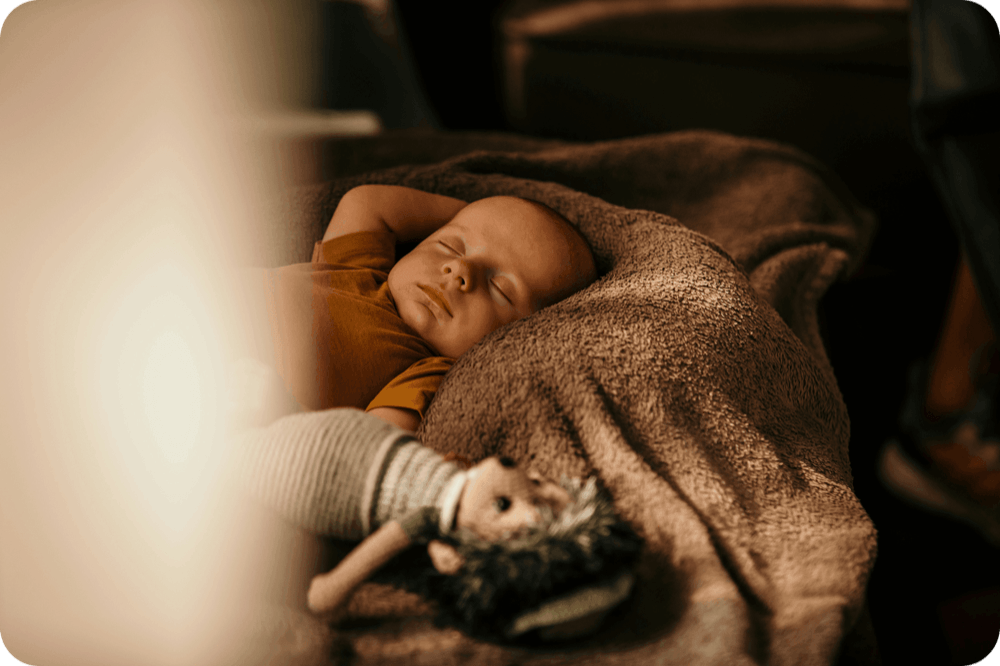
- A soft toy that “sleeps” with the baby
Rituals should last 10–20 minutes and repeat daily. Avoid screens 1–2 hours before bed.
How to adapt rituals to your family
Consider:
- Your schedule (e.g., one parent returns late)
- The baby’s energy levels
- Preferences: some kids are soothed by water, others get energized
- Need for contact vs. need for space
Cultural norms vary — some families co-sleep up to 2 years, others encourage independent sleep earlier. But the core of rituals is the same: creating predictability and security.
Should nap and night rituals differ?
Yes. This helps babies distinguish between wake and sleep phases.
- Night: longer, calming — dim lights, bath, quiet time
- Nap: shorter, no full darkness — just a story and a cuddle
Tips for changing routines
- Introduce changes gradually — one new element at a time
- Keep the order consistent — sequence matters more than the specific actions
- Stay flexible: favorite toys are okay
- Watch for tiredness cues — don’t wait for overtiredness
When to seek help
Consult a pediatrician or sleep specialist if your child regularly:
- Takes more than 40–60 min to fall asleep
- Wakes up crying often
- Sleeps less than 10 hours in total per day
- Cries during all bedtime attempts
With care
Our articles are based on evidence-based medicine and reviewed by pediatricians. However, they do not replace a consultation with your doctor. Every child is unique — if you have any concerns, please consult a medical professional.
 Essentials for baby care many parents choose
 https://amzn.to/3N0abpo


Some links in this article point to products or resources we genuinely find helpful for this topic. If you choose to buy through them, we may earn a small commission — at no extra cost to you.
Sources
- Kataria, Sudesh. (2004). A Clinical Guide to Pediatric Sleep: Diagnosis and Management of Sleep Problems. Journal of Developmental & Behavioral Pediatrics. 25. 132-133. 10.1097/00004703-200404000-00012. https://www.researchgate.net/publication/232166659_A_Clinical_Guide_to_Pediatric_Sleep_Diagnosis_and_Management_of_Sleep_Problems. Accessed 7 May 2025.
- Barbara C. Galland, Barry J. Taylor, Dawn E. Elder, Peter Herbison, Normal sleep patterns in infants and children: A systematic review of observational studies, Sleep Medicine Reviews, Volume 16, Issue 3, 2012, Pages 213-222, ISSN 1087-0792, https://doi.org/10.1016/j.smrv.2011.06.001. Accessed 7 May 2025.
- Weissbluth, M. (2021). Healthy Sleep Habits, Happy Child. Ballantine Books. ISBN-10: 0593158547
- Benjamin H. Gern, Amit Mehta, Amy N. McCammond, Kathryn W. Holmes, Judith A. Guzman-Cottrill; Case 1: Vomiting and Ventricular Arrhythmia in a 2-year-old Girl. Pediatr Rev February 2018; 39 (2): 91–92. https://doi.org/10.1542/pir.2016-0133. Accessed 7 May 2025.
- Caring for your baby at night and when sleeping, UNICEF. Accessed 7 May 2025.